User Researcher
June 2024 - July 2025
Led and supported a range of user research activities across multiple projects, including moderated and unmoderated studies such as user interviews, usability testing, card sorting, tree testing, first-click tests, and surveys.
Worked closely with the wider team, actively contributing to design critiques and advocating for evidence-based decision-making to ensure research insights directly informed design iterations and contributed to improvements in user experience.
Created and delivered stakeholder-facing research decks, clearly communicating findings, user pain points, and actionable recommendations.
Collaborated with engineers and product managers in a fast-paced, regulated environment to identify user and business problems, delivering solutions that balance compliance, commercial goals, and user needs
Led the creation and implementation of a scalable design system, working closely with engineers and designers to ensure consistency across Figma and Storybook
Conducted a comprehensive accessibility audit, identifying key compliance gaps and delivering improvements to enhance usability and meet accessibility standards
Produced high-fidelity prototypes and rapid mockups in Figma to validate ideas, communicate concepts, and accelerate delivery
Identified key pain points across multiple products and delivered high-impact design solutions to improve user experience and business performance
Used data analytics teams to uncover insights, inform design decisions, and prioritise opportunities across the platform
Balanced user needs with commercial objectives when defining and delivering product solutions
Design System
Energy Journey: Small but impactful improvements
My Account: Quickest way to quote
The project
One of my first projects at Go.Compare as a product designer was leading the creation of a rebranded design system to unify the experience across multiple domains. I also worked closely with engineers to translate designs from Figma into reusable components in Storybook, ensuring consistency between design and production.
This improved design-development alignment, reduced duplication, and enabled faster, more consistent feature delivery across teams.
The problem
We need to create a rebranded design system to implement across site. Currently, the product experience is fragmented, with inconsistent UI patterns and duplicated components, slowing down delivery and creating a disjointed user experience.
My role
I led the design of the new system, defining patterns, components, and guidelines, while collaborating closely with engineers to ensure feasibility and scalability.
My process
Audited existing components across products
Identified inconsistencies and duplication
Defined core design principles (e.g. accessibility, scalability)
Built reusable components in Figma
Partnered with engineers to implement components in Storybook
Iterated based on team feedback
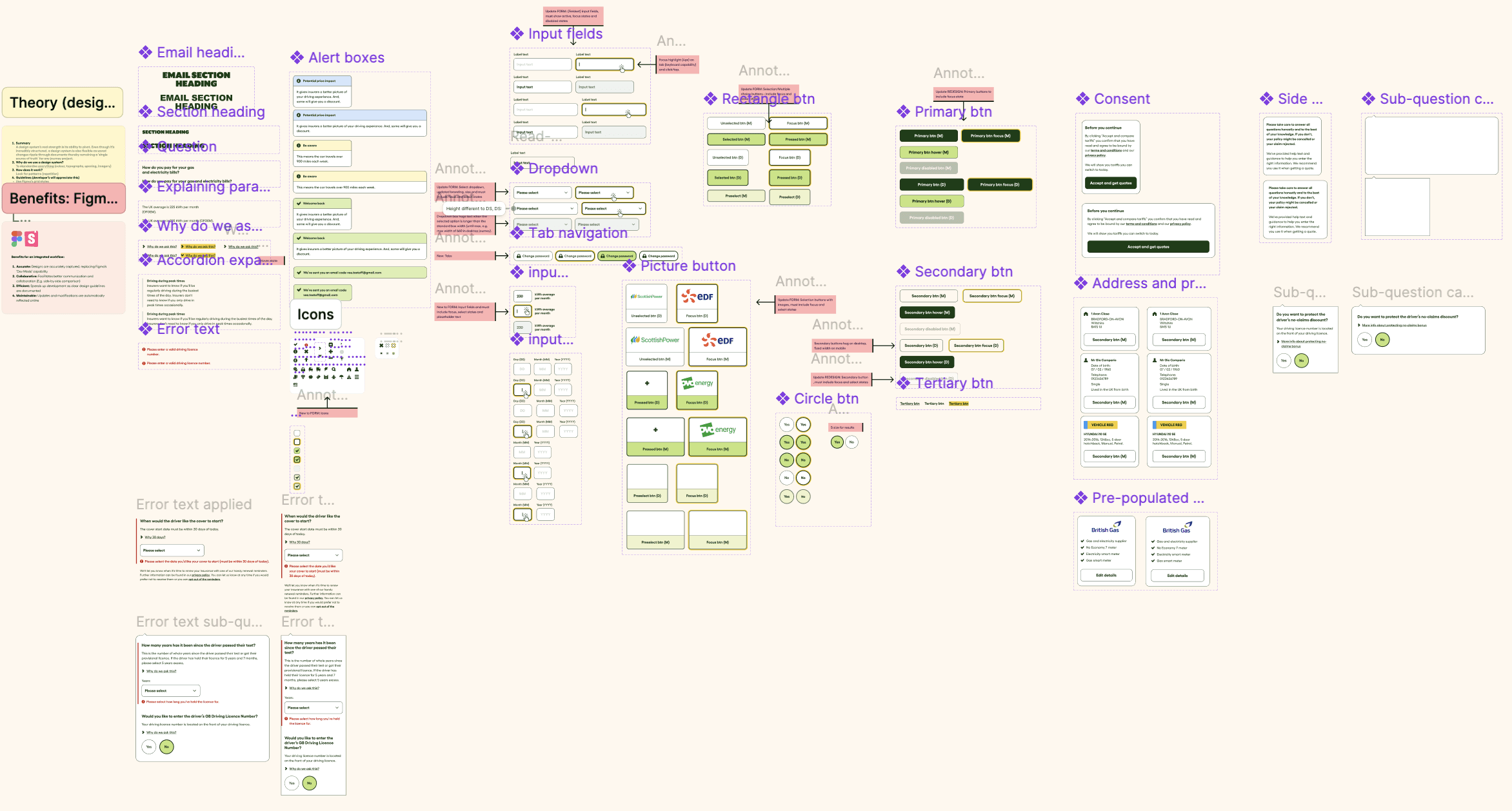
Figma
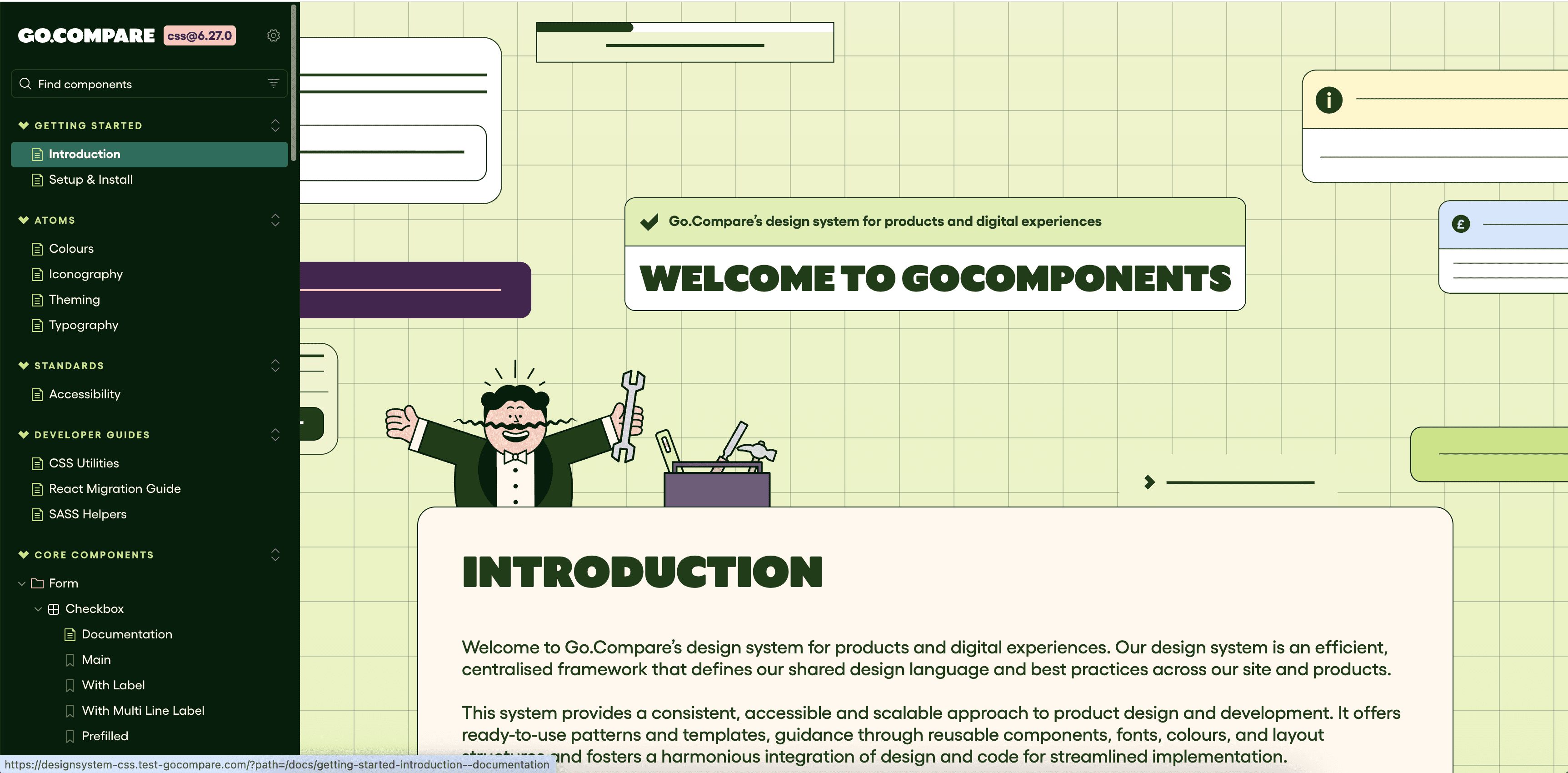
Storybook
The impact
The updated design system is currently being rolled out across platform, with full implementation already live on CMS and results pages, and core journeys and account areas in progress.
It has reduced design and development duplication, improved consistency across user journeys, and accelerated delivery by enabling teams to reuse components rather than redesign from scratch. This has significantly improved efficiency and collaboration across both design and engineering teams.
The problem
When users completed an energy comparison on Go.Compare, our quoted prices were often higher than competitors.
Through user feedback and data analytics, I identified a key issue in the “I don’t know” electricity usage flow:
The journey was overly complex and asked for difficult-to-answer questions (e.g. property age)
Users struggled to provide accurate inputs
This led to inaccurate estimates and reduced competitiveness
This created friction in the journey and negatively impacted conversion.
The objective
Simplify the “I don’t know” flow to:
Reduce user friction
Improve accuracy of inputs
Increase competitiveness of quotes
Ultimately improve conversion rates
My process
Created discovery deck, including comparing our current flow to competitors
Analysed energy consumption data across the UK to simplify potential options for customers
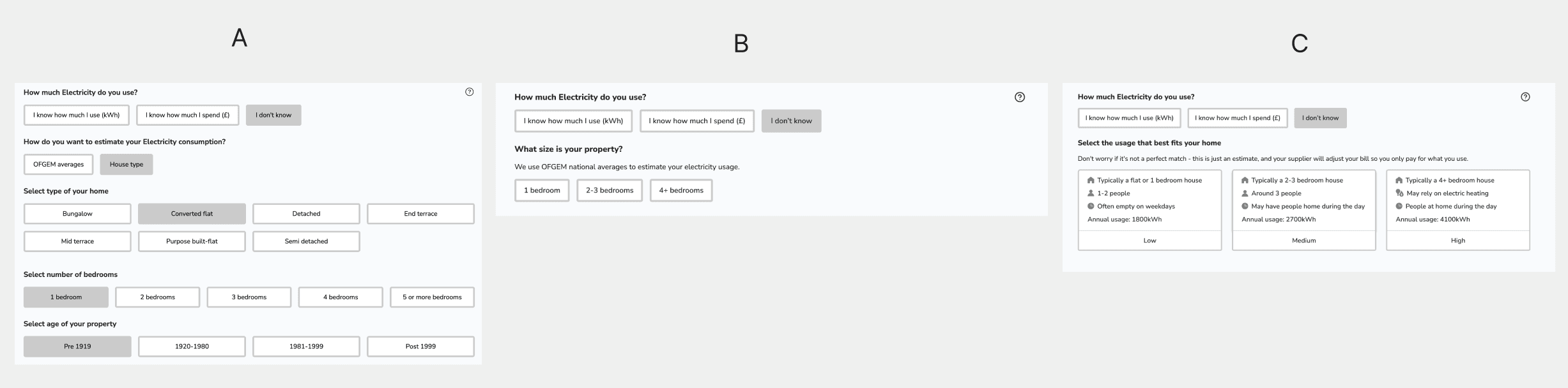
Designed simplified alternatives, creating an A/B/C test with three approaches:
Variant A – Control
Existing flow using OFGEM averages or property-based questions
Variant B – Bedrooms-based model
Users select number of bedrooms
Mapped directly to average consumption data
Variant C – Usage-based model
Users select Low / Medium / High usage
Supported with clear guidance to improve confidence
Based on industry datasets
The impact
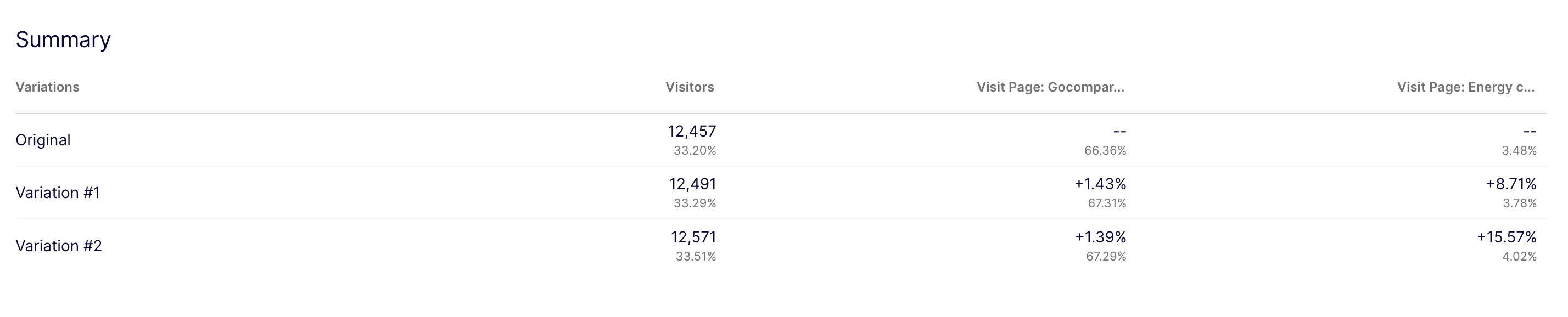
Both new variants outperformed the original experience:
Variant C (Usage-based) increased switches by +0.54%
Variant B (Bedrooms-based) increased switches by +0.30%
With both variants also increasing the % of users who clicked through to the results page
Key outcomes:
Reduced friction in a critical journey
Improved user understanding and confidence
Increased competitiveness of quotes
Delivered measurable commercial impact through conversion uplift
The problem
I took on the challenge of redesigning the experience for return customers on Go.Compare. Part of this was creating a feasible vision for the My Account area.
On the account, we present all quotes and information equally, regardless of where users are in their journey.
This created several issues:
Users have to scroll through potentially high amounts of outdated quotes to find the one they're looking for
Outdated quotes add cognitive overload
Key actions are not prioritised for users ready to purchase
Internal data showed that 72.7% of users complete their purchase within the same session or within 24 hours, highlighting a clear opportunity to better support returning users mid-journey.
The objective
Through discovery, data analysis and reviewing customer feedback & session replays, I decided to go with the approach of creating a dynamic account area that prioritises the most relevant quote, and dynamically reorders content depending on where customers are in their journey.
My approach
1. Reframing the experience around user intent
Rather than treating all content equally, I designed the page to adapt based on whether a user had an active quote.
2. Designing a dynamic, prioritised layout
For users with an active quote:
Introduced a highlighted tile surfacing the most recent active quote at the top
Repositioned less relevant content at this stage in their purchase journey (e.g. current active policy info, banners) lower on the page
Collapsed older quotes behind a “Show all previous quotes” toggle
Ensured all information remained accessible, but de-prioritised
3. Reducing cognitive load
Simplified hierarchy and visual prioritisation
Reduced on-screen clutter by collapsing less relevant information
Made key actions more prominent and easier to access
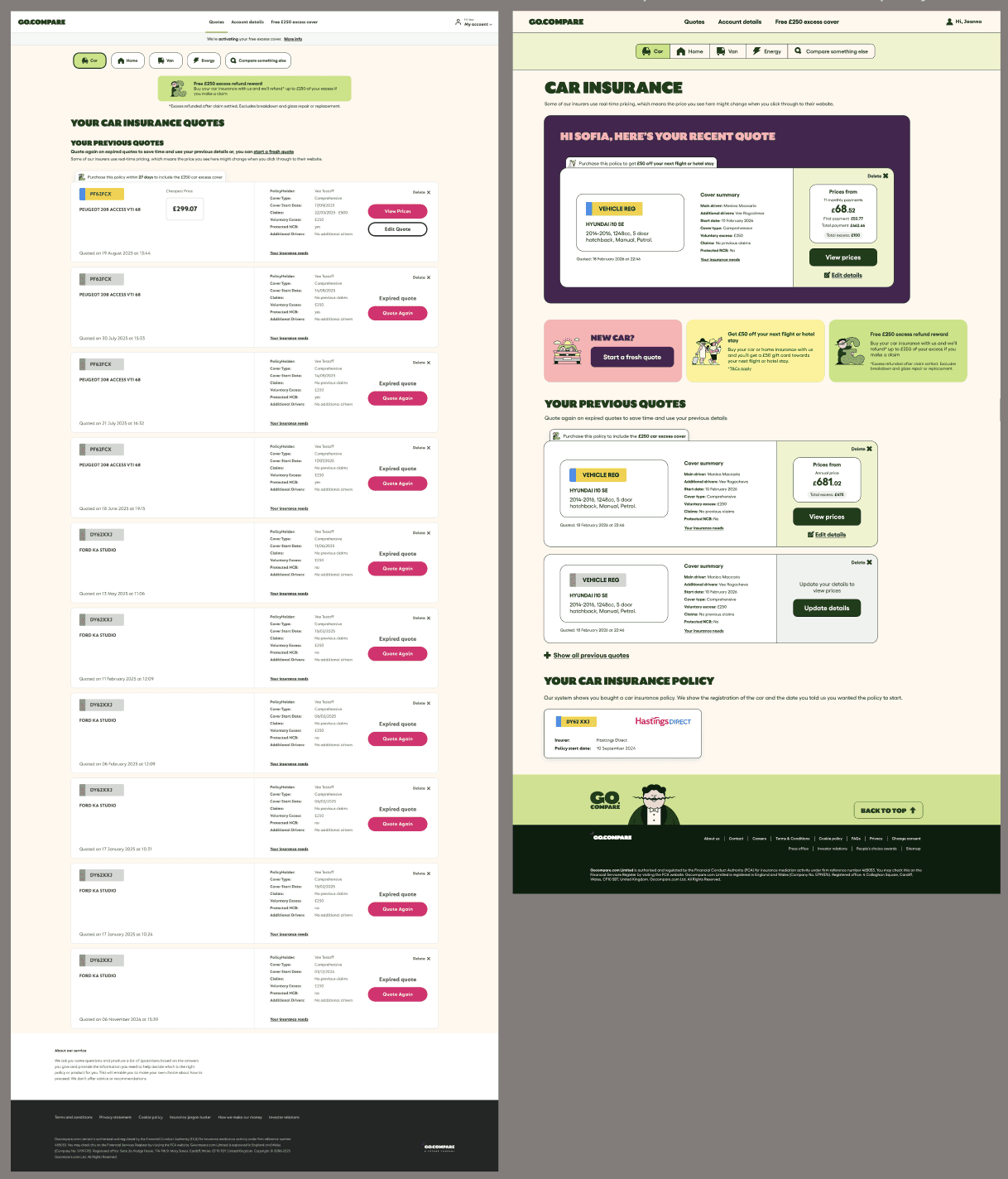
Account area: before and after
Sofia Durnford
Portfolio
Variant C